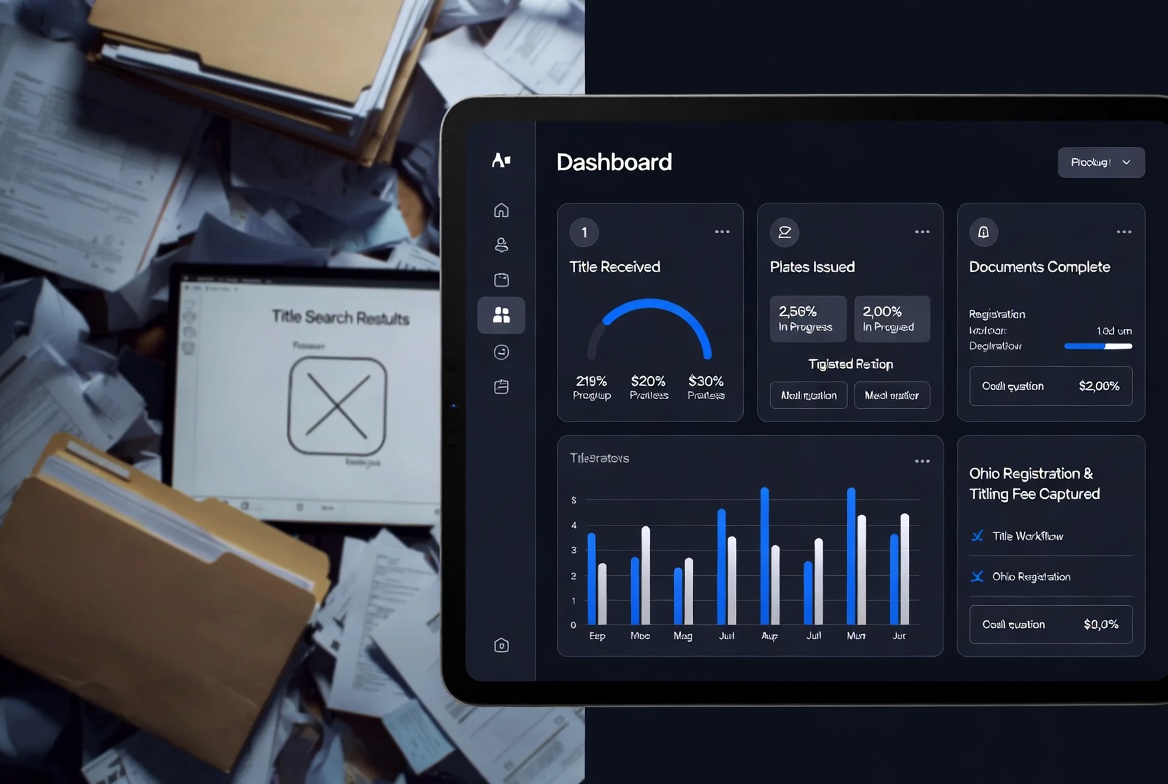
The title clerk already checked the title.
That was not where the deal got stuck.
The problem came later, when the file still had to move through registration, plates, scanned documents, status updates, lender follow-up, customer questions, and someone asking, “Where is this title?”
That is the part a normal Ohio title search does not solve.
A title search can confirm what the record shows. It can help the store see whether a title looks clean, whether a lien appears, or whether something needs a closer look.
But dealerships do not live in one lookup.
They live in the handoff after the lookup.
The deal jacket. The scan. The missing document. The rejected file. The title office run. The plate question. The manager asking for status. The title clerk carrying too much of the process in her head because the store never gave her a better system.
That is why Ohio dealerships should not confuse title search access with title workflow control.
If your store is still relying on paper files, spreadsheets, email chains, title office runs, or one experienced clerk’s memory to hold the process together, the issue is bigger than lookup. The issue is whether your dealership has a repeatable title and registration workflow.
For dealers ready to move from lookup to workflow control, EZ E Title gives Ohio dealerships an electronic titling system built around how title work actually moves through the store.
What an Ohio Title Search Actually Solves
An Ohio title search answers one narrow question:
What does the title record show right now?
That can matter. A dealership may need to confirm title status, lien information, branding, ownership history, or whether something looks wrong before the deal moves forward.
But the search does not move the transaction.
It does not show whether the deal jacket is complete.
It does not tell the office whether registration has been handled.
It does not issue plates.
It does not scan and organize supporting documents.
It does not show whether a transaction is queued, sent, under review, issued, or rejected.
It does not create a clean reporting path for management.
It does not help the store document whether the Ohio registration and titling service fee was applied properly.
For a consumer, an Ohio title search may be the end of the task.
For a dealership, it is one checkpoint inside a larger operating process.
The Real Problem Is the Handoff After the Lookup
Most title problems inside a dealership do not start because nobody could look something up.
They start because the handoff is messy.
The title clerk may know what is going on, but the rest of the store does not.
The sales desk asks for an update.
F&I needs to know whether the file is clear.
Accounting wants cleaner documentation.
A customer calls before anyone has a confident answer.
A manager asks for a list of outstanding titles, and the title clerk has to stop processing work to build the answer manually.
That is where the process starts costing the store time.
Not because the title clerk is weak.
Usually the opposite.
The title clerk is often the person keeping the whole process from falling apart.
But when a process depends too much on one person’s memory, notes, inbox, paper stack, or private spreadsheet, the dealership has a workflow risk.
A strong clerk can hide a weak process for a long time.
Until volume spikes.
Until someone is out.
Until a new clerk has to learn the desk.
Until a rejected file needs to be tracked.
Until ownership wants cleaner reporting.
Until the store realizes it is doing the work required to support registration and titling, but may not be capturing the fee opportunity consistently.
That is when a title search is not enough.
The Lookup vs Workflow Test for Dealerships
Use this test.
If the question is about one record, that is lookup.
If the question is about moving the deal correctly from start to finish, that is workflow.
Lookup asks:
Is there a title record?
Is there a lien?
Does the record show a brand?
Does the title appear clean?
Workflow asks:
Who owns the next step?
What document is missing?
Has the file been scanned?
Has it been submitted?
Is it queued, sent, under review, issued, or rejected?
Was registration handled?
Were plates handled?
Was the fee applied where appropriate?
Can management see status without interrupting the title clerk?
Can another trained person step in if the normal title clerk is out?
That is the difference.
A lookup gives information.
A workflow gives control.
Most dealerships do not need more places to check information. They need fewer places where work can disappear.
Where Manual Ohio Title Processing Leaks Time
Manual title processing rarely fails in one big dramatic moment.
It leaks in small ones.
A folder is on the wrong desk.
A document was scanned, but not attached where the next person needs it.
A title office run waits until there are enough files to justify the trip.
A rejected title sits longer than it should because the status is not visible.
A sales manager asks the title clerk for an update that should already be reportable.
A spreadsheet is accurate only because one person keeps it accurate.
A newer clerk does not know the exception path because the real process was never fully documented.
None of that shows up in a normal Ohio title search.
But that is where the dealership feels the pain.
This is also why paper workflows become harder as the store grows. The same process that feels manageable at lower volume starts creating more drag when the store sells more cars, adds staff, adds rooftops, or loses an experienced office person.
The title clerk should not have to be the system.
The system should help the title clerk control the process.
Why the Ohio Registration and Titling Service Fee Changes the Math
Ohio’s registration and titling service fee changed how dealerships should think about title work.
Ohio dealers may charge a registration and titling service fee of up to $50 per vehicle when the rule applies and the services are handled properly.
That makes the process more important.
The store is not just trying to reduce paperwork. It is trying to support a fee correctly, consistently, and defensibly.
That does not happen because someone knows the fee exists.
It happens because the workflow supports it.
If the process is manual, inconsistent, or handled differently from person to person, the store may be doing the work but not capturing the money consistently.
Simple example:
A qualifying Ohio transaction supports a $50 registration and titling service fee.
If the electronic titling cost on that transaction is $10, the potential retained amount is about $40.
That number is not the whole story. Dealers still need to follow the rule, disclose the fee properly, charge it only where allowed, and apply their own compliance process.
But it shows the business issue clearly.
Manual title work can mean the store takes on the hassle, does the work, and still leaves the fee opportunity on the table.
That is why the fee belongs in the workflow conversation, not just the accounting conversation.
For the full dealer-specific breakdown, see our guide to the Ohio Registration and Titling Service Fee.
Electronic Titling Does Not Replace the Title Clerk
This is important because title clerks may hear “electronic workflow” and think the dealership is trying to replace them.
That is not the goal.
A good title clerk is one of the most valuable people in the store.
They catch mistakes before they become expensive. They know which files are clean, which files need attention, and which details will create problems if they are missed.
The problem is not the title clerk.
The problem is the paper chase around the title clerk.
A better workflow should make the title clerk more valuable because it moves them out of low-value chasing and into higher-value control.
Instead of answering the same status questions, hunting down documents, checking side notes, or remembering which file is waiting on what, the clerk can manage the process with better visibility.
A good system should help them see what is queued, what was sent, what is under review, what was issued, what was rejected, and what still needs attention.
That is not replacement.
That is leverage.
What Ohio Dealer Title Processing Software Should Actually Control
A real dealer title workflow should control the points where work usually breaks.
Not just title submission.
Not just lookup.
Not just document storage.
The workflow should help the dealership control the full path around the transaction.
That means the system should support electronic titling, registration, plates, document scanning, Ohio Title Writer, lienholder lookup, deal-level documentation, status tracking, rejected file visibility, issued-title reporting, internal management visibility, support questions, and fee consistency.
The practical question is not, “Can we search a title?”
It is, “Can everyone who needs to know the status get the answer without chasing the title clerk?”
That is the real operational test.
If the answer is no, the dealership still has a workflow gap.
If your store is evaluating options, Ohio dealer title processing software should be judged by how well it reduces those exact handoff problems, not just whether it checks an electronic submission box.
Why Ohio-Specific Electronic Titling Workflow Matters
Some dealerships already use VITU, Dealertrack, CVR, or another provider.
That may solve part of the problem.
But “we have electronic titling” and “we have a clean Ohio title workflow” are not always the same thing.
When a dealer is comparing systems, the questions should be specific.
Does the system support electronic titling, registration, and plating in one workflow?
Does it reduce title office runs?
Does it include Ohio Title Writer?
Does scanning feed the process, or does it just store documents?
Can title status be tracked without side spreadsheets?
Can issued, rejected, pending, and problem files be reported clearly?
Can the office get help from people who understand Ohio title work?
Does the process support fee documentation consistently?
Does it make the title clerk’s job easier, or just add another screen?
Those are the questions that expose the gap.
National platforms may be strong in broad coverage, integrations, or multi-state capabilities. But Ohio dealers also need state-specific execution: county title office realities, Ohio registration and plating workflow, Ohio Title Writer, title clerk support, and the new fee structure.
That is where EZ E Title separates itself.
EZ E Title is not just a title lookup tool or a submission-only system. It brings electronic titling, registration, plating, scanning, Ohio Title Writer, title tracking, reporting, and Ohio-based support into one dealer workflow.
For Ohio stores, that one-stop-shop difference matters.
Not just submission.
Not just lookup.
A more complete title and registration workflow for the store.
Dealerships comparing broader national tools against Ohio-specific execution should also review how electronic titling software for dealerships supports the full process around title work, not just the single act of submitting a title.
The Quiet Risk: One Person Is Carrying the Title Process
Here is the part many dealerships know but do not always say out loud.
The title process often works because one person is carrying it.
One person knows where the files are.
One person remembers which titles are stuck.
One person knows which lender issue is still open.
One person remembers which customer is waiting.
One person knows which county office question has not been resolved yet.
One person knows which deals still need to be followed up.
That person may be excellent.
But that is still a fragile system.
A dealership does not really have process control if the answer to every title question is, “Ask her.”
That is not scalable.
It is not fair to the clerk either.
The title clerk becomes the help desk, the reporting system, the exception manager, and the memory bank for the store.
That is why electronic workflow is not just about speed.
It is about reducing key-person dependency.
The clerk should still own the expertise.
The system should carry more of the process.
When an Ohio Dealership Should Request a Demo
A demo makes sense when the dealership recognizes any of these patterns:
Your title clerk is still tracking work outside the system.
Paper files still control too much of the process.
Someone has to ask for title status because it is not visible.
Registration and plates feel disconnected from title work.
Rejected or problem files are harder to track than they should be.
Management cannot easily see issued, pending, or rejected title activity.
The store is unsure whether the registration and titling service fee is being applied consistently.
The store is using VITU, Dealertrack, CVR, or another system but still working around gaps.
A strong title clerk is keeping everything moving, but too much depends on that person.
Those are not small issues.
They are signs that the dealership has outgrown a paper-driven or partial workflow.
Another Ohio title search will not fix that.
A workflow review will.
If your dealership wants to compare its current process against a cleaner Ohio-specific workflow, schedule an EZ E Title demo and see how the process works in practice.
What to Ask Before Choosing Dealer Title Processing Software
Before choosing a title processing system, start with the failure points.
Where does work slow down?
Where does status disappear?
Where does the title clerk get interrupted?
Where does management lack visibility?
Where does fee handling become inconsistent?
Then ask whether the system fixes those exact points.
Use these questions:
Can we see title status without asking one person?
Can we manage titling, registration, and plates in one process?
Can we reduce title office runs?
Can we scan and attach documents where the work is happening?
Can we use Ohio Title Writer to reduce handwriting on the back of titles?
Can we see rejected, pending, and issued activity clearly?
Can we support fee documentation consistently?
Can new staff learn the process without rebuilding tribal knowledge from scratch?
Can we get support from people who know Ohio title work?
Does this make the title clerk more effective?
That last question matters.
The right system should not make a title clerk feel replaced.
It should make the title clerk harder to live without because they now have better control of the process.
Final Takeaway: Ohio Title Search Is Only the Checkpoint
An Ohio title search has a place.
It can help verify information.
But it does not manage title work.
It does not control registration.
It does not handle plates.
It does not organize documents.
It does not create status visibility.
It does not support fee consistency.
It does not reduce the paper chase by itself.
For dealerships, the search is only the checkpoint.
The workflow is the business process.
That is the shift serious Ohio dealers need to make.
If your store is still relying on paper, manual tracking, title office runs, disconnected systems, or one title clerk’s memory to hold the process together, it is worth seeing what a cleaner workflow looks like.
EZ E Title helps Ohio dealers move from title lookup to title control with electronic titling, registration, plating, scanning, Ohio Title Writer, reporting, and Ohio-based support in one process.
The goal is not to replace the title clerk.
The goal is to get them out of the paper chase and give the dealership a better way to manage the work.
See how EZ E Title works in a quick demo.
Frequently Asked Questions
What is an Ohio title search?
An Ohio title search is a way to check title-related information for a vehicle, including title status, lien information, ownership records, or title branding. For dealerships, it is useful, but it is only one checkpoint in the larger title and registration process.
Is an Ohio title search the same as electronic titling?
No. An Ohio title search verifies information. Electronic titling helps process title work electronically. A dealership may need both, but a title search does not replace a full workflow for documents, registration, plates, status tracking, and reporting.
Why is manual title processing a problem for Ohio dealerships?
Manual title processing can make the dealership too dependent on paper files, spreadsheets, email chains, title office runs, and one experienced clerk’s memory. That creates risk when volume increases, staff are out, files are rejected, or management needs visibility.
How does the Ohio registration and titling service fee affect dealers?
Ohio dealers may charge up to $50 per vehicle for qualifying registration and titling services when handled properly under the rule. That makes workflow, documentation, disclosure, and consistency more important for dealerships.
Does electronic titling replace the title clerk?
No. A strong electronic workflow does not replace the title clerk. It elevates the title clerk by reducing manual chasing and giving them better tools to manage status, documents, exceptions, and reporting.
When should a dealership request an EZ E Title demo?
A dealership should request a demo if it still uses paper, relies on manual tracking, makes title office runs, struggles with status visibility, has gaps with registration or plating, or wants a cleaner way to support the Ohio registration and titling service fee.