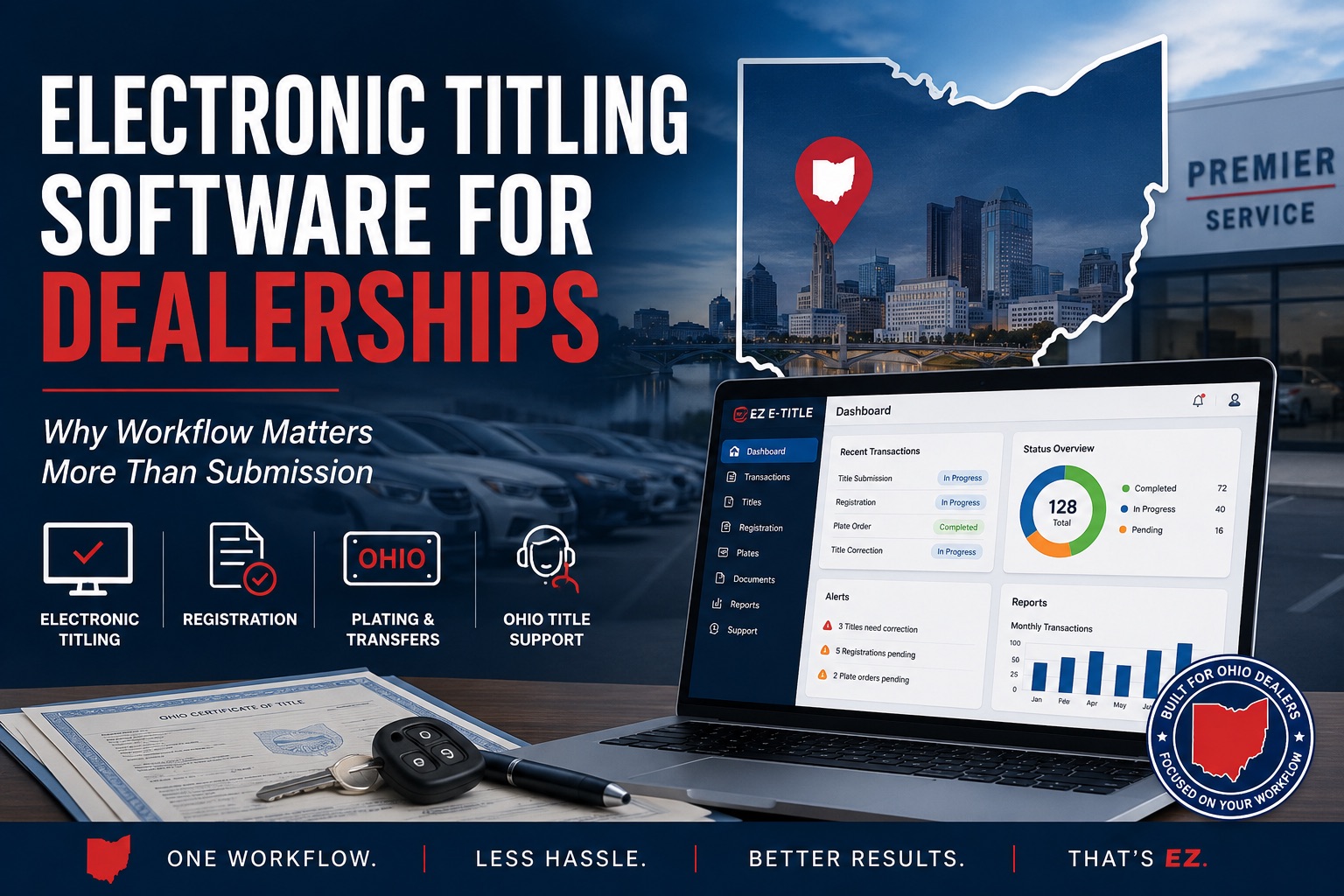
What Is Electronic Titling Software for Dealerships?
Electronic titling software for dealerships helps dealers prepare, submit, track, correct, and manage title work electronically instead of relying entirely on handwriting, runners, paper files, manual checks, and disconnected follow-up.
But that definition is too small if the software only handles the submission.
In a real dealership, title work does not live in a vacuum.
It touches the deal jacket.
It touches registration.
It touches plates and transfers.
It touches title backs.
It touches customer follow-up.
It touches the title office, accounting, F&I, sales, and sometimes ownership when something gets delayed long enough.
That is why the better category is not just electronic titling software.
It is title and registration workflow software.
The strongest systems help the dealership manage the entire path:
Electronic titling.
Registration.
Plating.
Title writing.
Document handling.
Corrections.
Reporting.
Status visibility.
Ohio title support.
That is where the work actually gets controlled.
For Ohio dealers comparing options, the key is understanding the difference between basic electronic title submission and a complete dealer electronic titling system in Ohio that supports the workflow around the title.
The False Belief: Electronic Submission Means the Process Is Fixed
The common false belief is simple:
“If we can submit titles electronically, our title process is modern.”
Not always.
A store can submit titles electronically and still have a broken title process.
The title might go out digitally, but the team may still be dealing with:
Manual rekeying.
Handwritten title backs.
Separate registration steps.
Separate plate or transfer workflows.
Scattered scans.
Unclear status.
Slow corrections.
Runner dependency.
Weak reporting.
New hires learning from memory instead of process.
That is the trap.
The dealership modernized one step.
The rest of the workflow stayed the same.
Where Title Work Usually Breaks
Most dealership title issues start small.
A county does not match.
A document is missing.
A buyer address needs cleaned up.
A title back is wrong.
The wrong version of a document gets used.
A transfer is waiting on another step.
A customer calls before anyone has a clean answer.
None of that sounds dramatic.
But inside a busy title office, small issues compound fast.
One correction can turn into multiple touches.
One missing document can slow down a deal for days.
One unclear status can trigger calls between sales, accounting, title, and the customer.
One person out of the office can stall the work because nobody else knows exactly where the deal stands.
That is why the software matters.
Not because software magically fixes every title problem.
Because a better workflow catches more issues earlier, ties the right documents to the right deal, keeps status visible, and gives the title office a cleaner path when something needs corrected.
The One-Person Risk
Every dealership has someone who “just knows.”
They know which title office to call.
They know which forms get missed.
They know how the county likes something handled.
They know where documents are saved.
They know how to fix common rejections.
They know which deal needs attention before it turns into a phone call.
That person is valuable.
But if the process only works because one person carries it in their head, the store has a risk problem.
That risk shows up when volume spikes.
It shows up when someone goes on vacation.
It shows up when a new person starts.
It shows up when a store adds another rooftop.
It shows up when the person who “just knows” leaves.
A strong title clerk should not have to hold the entire process together manually.
The system should make the process visible enough, structured enough, and repeatable enough that the dealership is not dependent on tribal knowledge to get clean title work done.
Workflow Matters More Than Submission
Electronic submission is one event.
Workflow is everything around that event.
A real dealership workflow includes:
Pulling the deal data.
Verifying buyer and vehicle information.
Checking county and tax details.
Preparing documents.
Handling title backs.
Managing registration.
Handling plates and transfers.
Scanning and attaching supporting documents.
Submitting electronically.
Tracking status.
Fixing corrections.
Printing or mailing what needs to move.
Reporting on what happened.
Answering internal and customer questions.
If those steps are disconnected, the dealership still has friction.
It may have electronic submission.
But it does not have control.
That is the line dealers need to understand when comparing electronic titling software for dealerships.
What Ohio Dealers Should Actually Look For
Ohio dealers should not evaluate electronic titling software like a checklist of features.
They should evaluate whether the system makes the title office easier to run on a normal, messy dealership day.
A normal day includes bad data.
Interruptions.
Customers calling.
Missing documents.
Corrections.
Transfers.
New people asking questions.
Management wanting status.
Deals that are not as clean as the demo file.
The right system should help with the real work:
Electronic titling.
Registration.
Plating and transfers.
Ohio Title Writer or title-back support.
Document scanning and attachment.
Status visibility.
Correction handling.
Reporting.
DMS workflow support where applicable.
Multiple users or rooftops.
Training.
Live Ohio title support.
The question is not:
“Does it have electronic titling?”
The question is:
“Can our team run title and registration work cleaner every day?”
That is the standard.
How Ohio’s Registration and Titling Service Fee Changes the Conversation
Ohio’s Registration and Titling Service Fee changed the conversation because title and registration work is no longer just a cost center hiding in the back office.
For qualifying transactions, the workflow may now support a properly disclosed fee.
Under Ohio Administrative Code Rule 4501:1-6-12, a motor vehicle dealer may charge a registration and titling service fee not to exceed $50 per vehicle leased or sold to the customer for services provided, plus mailing costs if applicable. Only one fee may be charged per vehicle transaction.
That matters.
But the fee is not magic.
The worst way to think about it is:
“We can just charge another fee.”
The better way to think about it is:
“If we are charging for this work, our process should be clean enough to justify it.”
That means the title and registration workflow should be structured, documented, supported, and consistent.
The fee does not create the value by itself.
The workflow creates the value.
The fee may help the dealership capture or recover value for the work being performed, but the process is what supports the customer experience, internal control, speed, documentation, and compliance posture.
For more detail on the rule itself, see Ohio Registration and Titling Service Fee.
Why Free or Basic Tools May Not Be Enough
Free or basic tools can be useful.
They may help a dealer complete a specific step.
But a tool is not the same thing as a workflow.
A free tool may still leave the store dealing with disconnected registration, separate plate handling, limited reporting, no title writing support, scattered documents, weak visibility, and no real help when something gets stuck.
That might work for a low-volume store with a simple process.
It becomes a problem when the dealership has volume, multiple people touching title work, multiple rooftops, or leadership trying to understand whether the new fee opportunity is being handled correctly.
For many Ohio dealers, the question is not whether a free tool can submit something.
The question is whether the process is strong enough to support the way the dealership actually operates.
For a deeper comparison, see Free BMV vs Dealer-Paid Electronic Titling Systems in Ohio.
The Submission Trap
The most common mistake is the Submission Trap.
A dealership adopts a system that solves the submission step.
At first, it feels like progress.
Then the hidden work comes back.
Someone still reconciles documents manually.
Someone still checks status somewhere else.
Someone still handles registration separately.
Someone still follows up on corrections.
Someone still trains the next person from memory.
Someone still answers customer questions without a clean view of the transaction.
That is not a modern title process.
That is digital submission sitting inside an old workflow.
The better model is workflow-first.
Electronic titling should sit inside one connected process that helps the dealership control the work before, during, and after submission.
That is the difference EZ E-Title is built around.
Why EZ E-Title Is Different
EZ E-Title is not just a way to submit titles electronically.
It is a one-stop workflow for Ohio dealerships that need electronic titling, registration, plating, Ohio Title Writer, reporting, and live Ohio title support working together.
That matters because the real dealership pain is rarely one isolated task.
It is the space between tasks.
The gap between title and registration.
The gap between registration and plates.
The gap between a document being scanned and someone knowing where it is.
The gap between a correction being needed and the right person seeing it fast enough.
The gap between charging a fee and having a process strong enough to support that fee.
EZ E-Title helps close those gaps.
For dealerships, that can mean:
Less handwriting.
Less runner dependency.
Faster correction handling.
Cleaner registration and plating workflow.
Better transaction visibility.
Support from Ohio title experts.
More consistent documentation.
A stronger process behind the Registration and Titling Service Fee conversation.
This is why a demo matters.
A dealership can read about workflow all day, but the value becomes much clearer when the team sees how a title moves from deal data to submission, correction, registration, plating, reporting, and support inside one process.
To see the system, visit Dealer Electronic Titling System in Ohio.
Frequently Asked Questions
What is electronic titling software for dealerships?
Electronic titling software helps dealerships prepare, submit, track, correct, and manage title work electronically. Stronger systems also support registration, plating, document handling, reporting, corrections, and support.
Is electronic title submission enough for a dealership?
Not always. Submission is only one step. Dealerships also need a clean workflow around data, documents, registration, plating, corrections, status visibility, reporting, and customer follow-up.
Why does workflow matter in dealership titling?
Workflow matters because many title delays come from disconnected steps, manual entry, unclear status, missing documents, correction cycles, and overreliance on individual memory.
How does Ohio’s Registration and Titling Service Fee affect dealership workflow?
Ohio’s fee rule makes workflow more important because qualifying dealers need to understand whether their process, provider structure, documentation, and disclosure practices support the fee correctly.
What should Ohio dealers look for in an electronic titling provider?
Ohio dealers should look for electronic titling, registration support, plating support, title writing, document control, reporting, correction handling, training, multiple-user support, and live Ohio title expertise.
Submission Is Only One Part of Electronic Titling
Electronic titling software should not be judged only by whether it can submit a file.
For dealerships, the bigger question is whether the process supports the daily work around the submission.
That includes registration, plates, scanning, title status, rejected files, reporting, and visibility for the title clerk, controller, office manager, and management team.
A dealership may technically have electronic titling and still have a broken workflow around it.
That is why workflow matters more than submission alone.
Dealers that want to see how EZ E Title connects the full process can review the Dealer Electronic Titling System Ohio page.
For a deeper software comparison, review Ohio Dealer Title Processing Software.
The Next Step for Ohio Dealers
A dealership can have good people and still have a weak title workflow.
That is the part most stores eventually run into.
Title clerks should not have to hold the process together with memory, handwritten steps, scattered documents, workarounds, and constant follow-up.
A modern dealership needs a title and registration workflow that is visible, repeatable, supported, and easier to run every day.
Electronic titling software should not just help the dealership submit.
It should help the dealership control the work.
If your dealership is reviewing electronic titling software, or trying to understand whether your current process supports Ohio’s Registration and Titling Service Fee correctly, the best next step is simple:
Schedule a quick EZ E-Title demo.
In 15 to 20 minutes, your team can see how electronic titling, registration, plating, Ohio Title Writer, reporting, corrections, and live Ohio title support work together in one connected workflow.
That comparison usually makes the gaps clear.