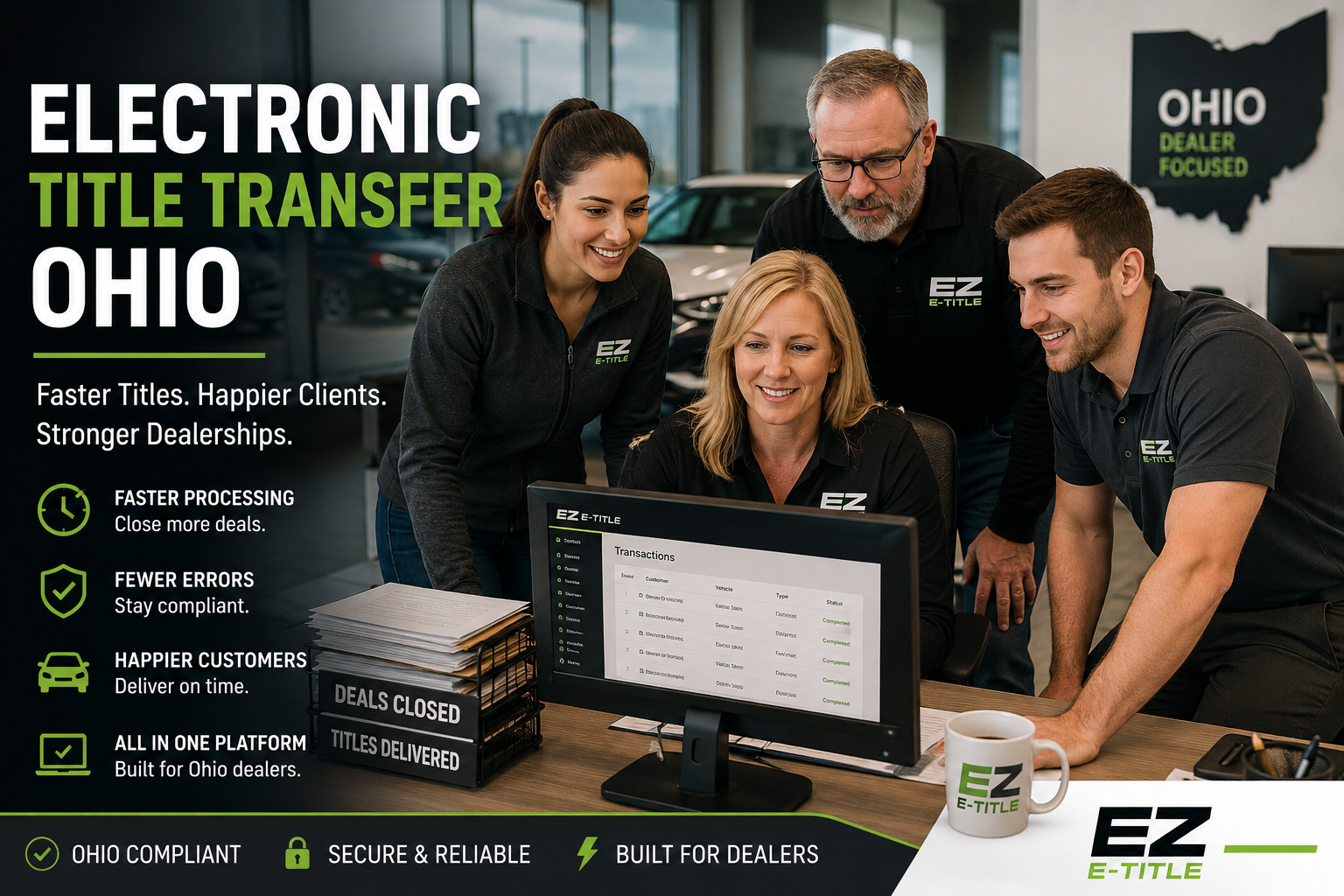
Electronic title transfer Ohio sounds simple until a dealership is dealing with 40 open title items, three trade titles that are not clean, and a plate issue waiting on registration.
It usually does not blow up all at once.
It starts with one trade title that is not clean.
Then a name does not match. A lien release is still missing. A customer signed in the wrong spot. A plate question is waiting on registration. Someone has to re-check the deal jacket because the paperwork looked fine when it came in, but now the title desk is finding the problem two days later.
Nobody in the store calls that a software issue.
They call it title work.
But when the same thing happens across 20, 50, or 100 deals, it is not just title work anymore.
It is a workflow problem.
That is why electronic title transfer Ohio matters differently for dealerships than it does for consumers.
A consumer may be trying to understand how one title gets transferred. A dealership is trying to move title work through retail deals, trade-ins, registration, plating, lien information, fee documentation, customer expectations, and month-end pressure without the entire process depending on one experienced title clerk catching every exception.
For Ohio dealerships, electronic title transfer is not just about making a title digital.
It is about making the title process harder to break.
For stores that want a cleaner process, an electronic titling system for Ohio dealerships should connect title work, registration, plating, and documentation into a workflow the team can actually repeat.
What Electronic Title Transfer Ohio Means for Dealerships
Electronic title transfer in Ohio means vehicle title work can move through an electronic process instead of relying entirely on traditional paper-based handling.
For dealerships, that definition is too small.
The real issue is not whether one title can move electronically. The real issue is whether the dealership has a reliable process around the title.
That process usually touches:
Retail deal paperwork
Trade title follow-up
Lien and payoff information
Registration
Plate work
Title corrections
Fee itemization
Customer communication
Internal tracking
That is why dealership electronic title transfer is different from consumer title transfer.
A consumer has one transaction.
A dealership has an operation.
And operations break in the handoffs.
The title does not get delayed because one person is lazy. It gets delayed because the process has too many places where something can be missed, re-entered, corrected, chased, or remembered manually.
The uncomfortable truth is simple:
Many dealerships do not have a title workflow.
They have good people compensating for a weak workflow.
That works until volume increases, the title clerk gets buried, a new employee has to be trained, a trade title goes sideways, or management starts asking why the same problems keep showing up at month-end.
Where Electronic Title Transfer Ohio Gets Messy Inside Dealerships
The title desk rarely gets wrecked by one dramatic issue.
It gets worn down by repeat friction.
A few examples show up over and over.
Trade titles that are not ready when everyone assumes they are
Trade titles are one of the biggest sources of hidden delay.
The sale may feel done on the front end, but the back office is still waiting on a title, a payoff, a signature, a lien release, or a correction.
That is where the title clerk becomes the tracking system.
Who has the title?
Was the payoff handled?
Did the customer sign correctly?
Is the lienholder release complete?
Is the title clean enough to move forward?
When that information lives in someone’s head, on paper, in email, or across disconnected tools, the process becomes fragile.
Small corrections that eat the week
A missing signature may only take a few minutes to chase.
A name mismatch may only require a quick correction.
A scanned document may only need to be cleaned up or resent.
But small corrections repeated across dozens of deals are not small anymore.
Five minutes here and ten minutes there can turn into hours of lost back-office time every week.
That is the cost most dealerships do not track.
They track software expense.
They usually do not track the cost of rework.
Registration and plating questions that interrupt title work
Title, registration, and plating are connected inside the dealership.
When those steps are handled separately, someone has to bridge the gap manually.
That usually means more status checks, more customer calls, more internal follow-up, and more pressure on the same people already trying to clear title work.
A customer does not care whether the delay is title, registration, plate, paperwork, or bank related.
They just know they are waiting.
Month-end cleanup
Title problems often become louder near month-end.
The deal is sold. The vehicle is gone. The customer thinks everything is handled. But the back office is still cleaning up paperwork, waiting on title-related items, chasing corrections, or trying to explain why something is not finished.
That is where weak title workflow becomes visible to management.
Not because the title clerk suddenly failed.
Because the process was already strained.
Why Free Tools Are Not the Same as a Dealer Electronic Titling System
This is where many dealerships misjudge the problem.
A free tool may help complete a narrow task.
A dealership needs a repeatable workflow.
Those are not the same thing.
A title lookup helps someone find information.
A dealer electronic titling system helps the store move work.
That is the difference.
This is why Ohio dealerships should understand the gap between free BMV tools and paid dealer electronic titling systems.
The question is not simply:
“Can we do part of this for free?”
The better question is:
“How much manual work, rework, delay, and follow-up is our current process creating?”
Because the visible cost of a tool is easy to see.
The hidden cost of manual work is harder to see.
It shows up as title clerk stress, customer calls, delayed processing, duplicate entry, messy training, unclear documentation, and managers asking for updates the system should already make easier to find.
A dealership can save money on a tool and still lose money in the workflow.
Electronic Title Transfer and Ohio’s Registration and Titling Service Fee
The Ohio registration and titling service fee has made title workflow more important.
Not because the fee is the whole opportunity.
Because the fee puts more attention on the process behind the work.
If a dealership charges a registration and titling service fee, the store should be able to explain what work is being performed, how the fee is disclosed, how it is itemized, and how the process is handled consistently.
That is why the Ohio registration and titling service fee should not be treated as just a line item.
It is connected to workflow.
Dealerships should always confirm their own disclosure, tax, documentation, and compliance requirements with the right legal, regulatory, or accounting guidance.
But operationally, the standard is clear:
If the store charges for registration and titling work, the process behind that charge should be real, consistent, and explainable.
Three questions matter:
Can we explain the work being performed?
Can we clearly separate dealer service fees from government fees?
Can we handle this the same way across deals?
If those answers depend on one person remembering how everything was handled, the dealership does not have a strong process.
It has a person carrying the process.
Signs Your Dealership Has Outgrown Manual Title Processing
Most dealerships do not realize the title process is a problem until the symptoms are already familiar.
The title clerk is constantly chasing missing information.
Trade titles keep slowing down deals.
Registration and title work feel disconnected.
Customers call about plates, title, or registration status.
The same information gets entered more than once.
New employees are hard to train because “how we do it” lives mostly in someone’s head.
Month-end brings the same cleanup pressure.
Fee documentation is becoming more important.
The current process works, but only because good people are absorbing the friction.
That last one is the real warning sign.
A strong employee can hide a weak process for a long time.
But that does not make the process strong.
It only means the dealership has not felt the full cost yet.
What Ohio Dealerships Should Look For
Do not start with this question:
Can it process titles?
That is too narrow.
Start here:
Will this make our title, registration, plating, and documentation workflow cleaner?
A strong Ohio dealer electronic titling system should help the dealership reduce manual touchpoints, manage title work more consistently, support registration and plating workflow, improve documentation, make training easier, and give the back office a process that does not depend entirely on memory.
It should also be built around how Ohio dealerships actually operate.
Generic title software is not enough.
Consumer title lookup content is not enough.
A dealership needs a system that supports the daily reality of title clerks, office managers, controllers, and dealer principals.
For stores comparing options, a dealer electronic titling system in Ohio should be evaluated as an operational platform, not just a transaction tool.
How EZ E Title Helps Ohio Dealerships
EZ E Title helps Ohio dealerships streamline electronic titling, registration, plating, and title processing through a workflow built around dealership operations.
The value is not just completing an electronic title task.
The value is helping the dealership move away from disconnected title steps and toward a process the team can repeat.
EZ E Title supports:
Electronic titling
Registration
Plating
Title processing
Trade title workflow
Ohio Title Writer
Dealer-focused training
Back-office workflow support
For stores evaluating the broader Ohio electronic title system, the real question is not whether electronic title transfer is possible.
The better question is whether the dealership has the right process to handle title work consistently at the store level.
EZ E Title helps dealerships move from title tasks to title workflow.
That is the difference. Schedule a 15-minute walkthrough here.
FAQ: Electronic Title Transfer in Ohio for Dealerships
What is electronic title transfer in Ohio?
Electronic title transfer in Ohio refers to handling vehicle title work through an electronic process instead of relying only on paper. For dealerships, it can support title processing, registration, plating, trade title handling, and workflow consistency.
Is electronic title transfer the same as a title lookup?
No. A title lookup helps someone find title-related information. Electronic title transfer is part of the process used to move title work through a dealership workflow.
Why should dealerships use electronic title transfer?
Dealerships use electronic title transfer to reduce manual work, improve title clerk efficiency, support workflow consistency, and manage title and registration volume.
Does electronic title transfer help with the Ohio registration and titling service fee?
It can support a more consistent workflow around titling and registration. Dealerships should still confirm their own disclosure, itemization, tax, and compliance requirements.
Where Electronic Title Transfer Fits in the Dealer Workflow
Electronic title transfer is important, but it should not sit by itself.
For dealerships, the strongest process connects electronic titling with registration, plating, scanning, title status, reporting, and clear exception handling.
That matters because the title clerk is not just transferring a title.
They are managing a live workflow with documents, deadlines, questions, and status updates coming from multiple directions.
EZ E Title helps Ohio dealers bring those pieces together in a more complete workflow.
For the full platform overview, review Dealer Electronic Titling System Ohio.
For software comparison and selection criteria, review Ohio Dealer Title Processing Software.
Connect the Title Transfer Process to the Full Dealer Workflow
The Ohio title transfer process is only one part of the dealership’s larger title and registration workflow.
A store still needs to manage electronic titling, registration, plating, document handling, title status, rejected files, and reporting in a way the title clerk and office team can follow every day.
That workflow becomes even more important when the dealership is evaluating how the Ohio registration and titling service fee fits into its process.
The issue is not just whether the title transfer is completed.
The issue is whether the dealership has a consistent process that supports visibility, documentation, and cleaner handoffs from start to finish.
For the broader system, review the Dealer Electronic Titling System Ohio page.
For software-specific comparison, see the Ohio Dealer Title Processing Software guide.
For fee-related workflow details, review the Ohio Registration and Titling Service Fee page.
The Bottom Line on Electronic Title Transfer in Ohio
Electronic title transfer in Ohio is not just a technology upgrade.
For dealerships, it is a workflow decision.
If your store still relies on manual steps, disconnected tools, title clerk memory, and back-office workarounds, the issue probably is not effort. Your people are likely already working hard.
The issue is the process underneath them.
A better electronic title transfer workflow can reduce friction, support cleaner documentation, improve title clerk efficiency, and connect title, registration, and plating into a more consistent operating system.
EZ E Title helps Ohio dealerships streamline electronic titling, registration, plating, and title processing through a workflow built for real dealership operations.
If your store wants to see how electronic title transfer works inside an Ohio dealership workflow, schedule an EZ E Title demo and take a closer look at the process.