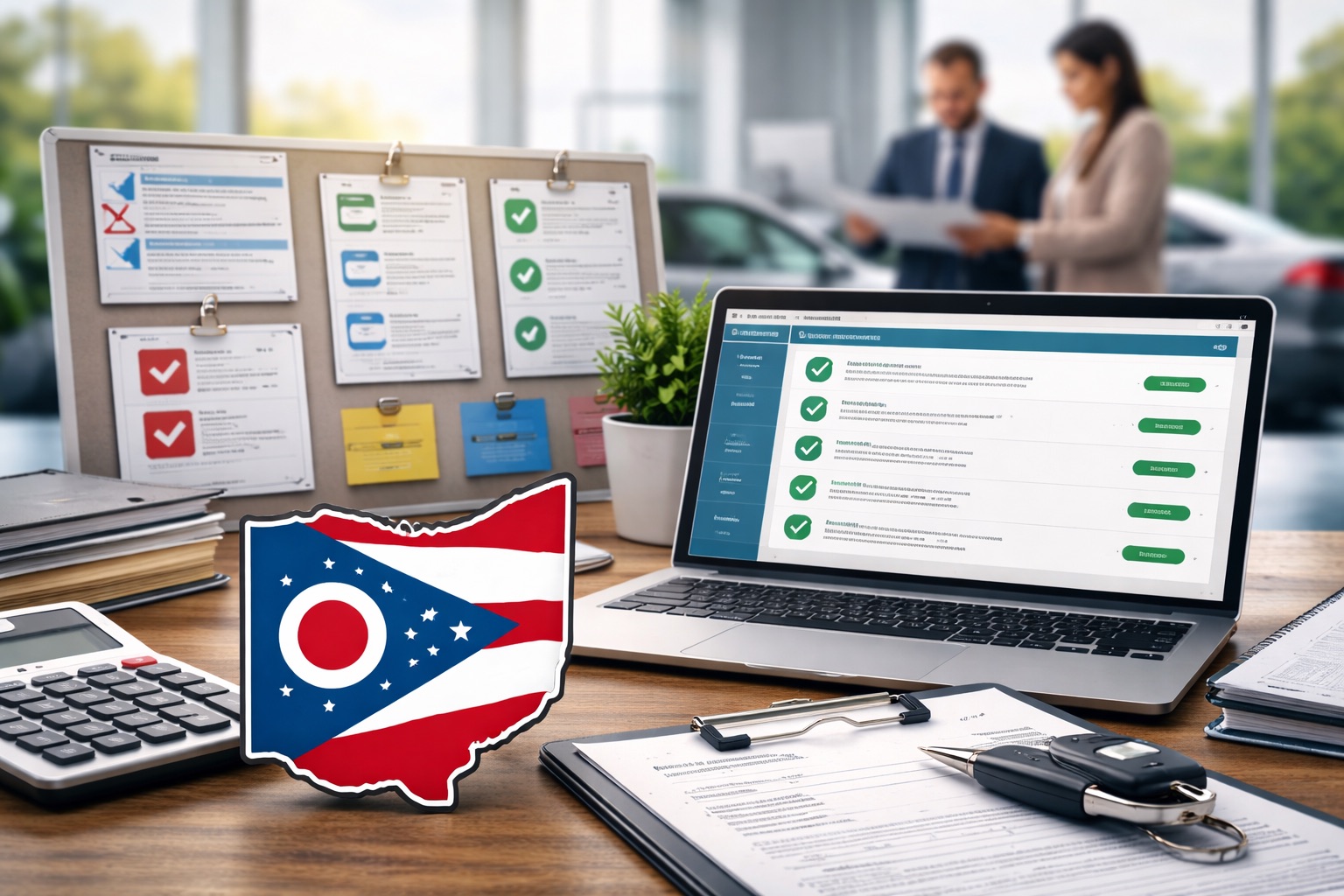
Ohio $50 Registration & Titling Service Fee Workflow: How Dealerships Operationalize the Rule
Quick Answer
How should Ohio dealerships operationalize the $50 Registration & Titling Service Fee rule?
Dealerships must embed the rule into their workflow, not just pricing. That means selecting the right electronic titling system, standardizing itemization labels, building documentation into the process, training staff on eligibility rules, and ensuring controller oversight. Compliance success comes from process control, not one-time policy updates.
Most Dealers Understand the Rule. Very Few Have Operationalized It.
The March 1, 2026 rule allows Ohio dealerships to charge up to $50 once per transaction when:
• qualifying dealer registration services are performed
• or dealer-paid electronic titling services are used
• the fee is separately itemized
• proper documentation exists
But knowing that doesn’t protect you.
Because the rule is not a pricing change.
It is a process control rule.
Dealerships that treat this like a line item update create:
• inconsistent application
• documentation gaps
• audit risk
• chargeback exposure
Dealerships that operationalize it create:
• defensible revenue
• consistent compliance
• audit protection
This guide explains how to embed the rule into dealership operations.
Step 1: Stop Treating This as a Finance Office Issue
This rule affects:
• Title clerks
• F&I managers
• Controllers
• Store management
• IT / DMS configuration
If only F&I understands the rule, different departments will apply it differently. That variability is exactly what regulators look for.
This is a dealership workflow issue, not a desk-level decision.
Step 2: Lock in Your System Decision First
Before anything else, dealerships must decide:
Are we using free BMV tools or a dealer-paid electronic titling system?
Because as explained here:
Free BMV vs Dealer-Paid Electronic Titling Systems Ohio
This choice determines:
• fee eligibility
• documentation quality
• audit defensibility
• multi-store consistency
Free tools may process titles.
They do not provide structured workflow enforcement.
System choice is now a compliance decision.
Step 3: Standardize Labeling Across All Rooftops
Every store must use the exact same line item wording.
See full itemization rules here:
How to Itemize Ohio Registration & Titling Fees Without Failing an Audit
If Store A says “Title Processing”
and Store B says “Service Fee”
you have created inconsistency across transactions.
Auditors do not examine one deal.
They look for patterns.
Consistency removes red flags.
Step 4: Build Documentation Into the Workflow
The rule requires proof that qualifying services were performed. That means being able to show:
• electronic submission confirmations
• dealer-performed service evidence
• eligibility conditions met
• no use of free-only systems
• fee applied once per vehicle
If documentation depends on someone remembering to save files, you do not have a defensible system.
That’s why dealerships use structured processes like the
Ohio Titling Service Fee Compliance Checklist
Documentation must be part of the workflow, not a follow-up task.
Step 5: Train Staff on When NOT to Charge the Fee
Most compliance failures come from ineligible application, not underuse.
Staff must understand prohibited situations outlined here:
Ohio $50 Service Fee Prohibited Practices Dealerships
Overuse triggers:
• refunds
• disputes
• chargebacks
• audit review
Training protects both revenue and compliance.
Step 6: Make Controllers Part of the Oversight Process
Controllers should review:
• itemization consistency
• single-fee enforcement
• tax treatment
• documentation completeness
This rule impacts accounting compliance as much as operational compliance.
Step 7: Eliminate Manual Variability
Manual processes lead to:
• different habits
• different labels
• different documentation standards
• different interpretations
Variability equals risk.
Structured systems enforce:
• eligibility checks
• single-fee limits
• standardized labels
• required documentation
Automation protects consistency.
What Happens When Dealers Don’t Operationalize
We see:
• different stores doing different things
• missing documentation
• label changes
• bundled charges
• inconsistent application
That reduces revenue and creates exposure.
What Proper Operationalization Looks Like
A compliant dealership:
✔ uses a structured electronic titling workflow
✔ standardizes labels across all stores
✔ embeds documentation into the process
✔ trains staff on eligibility
✔ involves controllers
✔ applies the fee consistently and defensibly
That’s not theory. That’s operational design.
Final Thought for Dealership Operators
The March 1 rule rewards dealerships with structured systems.
It exposes dealerships running on habit.
Compliance is not about knowing the rule.
It is about embedding the rule into your workflow.
Operationalizing the Fee Starts With the Title Process
The Ohio registration and titling service fee is not only a pricing issue.
It is an operational issue.
For the fee to be handled cleanly, the dealership needs a repeatable process around registration, title work, documentation, itemization, and internal visibility.
That process should not depend on one person remembering every step or tracking the work in disconnected places.
A stronger electronic titling workflow gives the office a clearer path to manage the work consistently.
Dealers looking for the main fee overview can review the Ohio Registration and Titling Service Fee page.
For the platform behind the workflow, review Dealer Electronic Titling System Ohio.
Call to Action
Want to see a fully operationalized, compliant workflow in action?
Set up your fast and fun demo here:
👉 EZ ETitle DEMOs are Fun, Fast, and FREE.
We’ll show:
• how eligibility is enforced
• how labeling stays consistent
• how documentation is created automatically
• how to protect revenue and reduce audit risk
Because this rule isn’t about fees.
It’s about process control.