Why Ohio Dealerships Need One Workflow for Electronic Titling, Registration, and Plating
Quick Answer
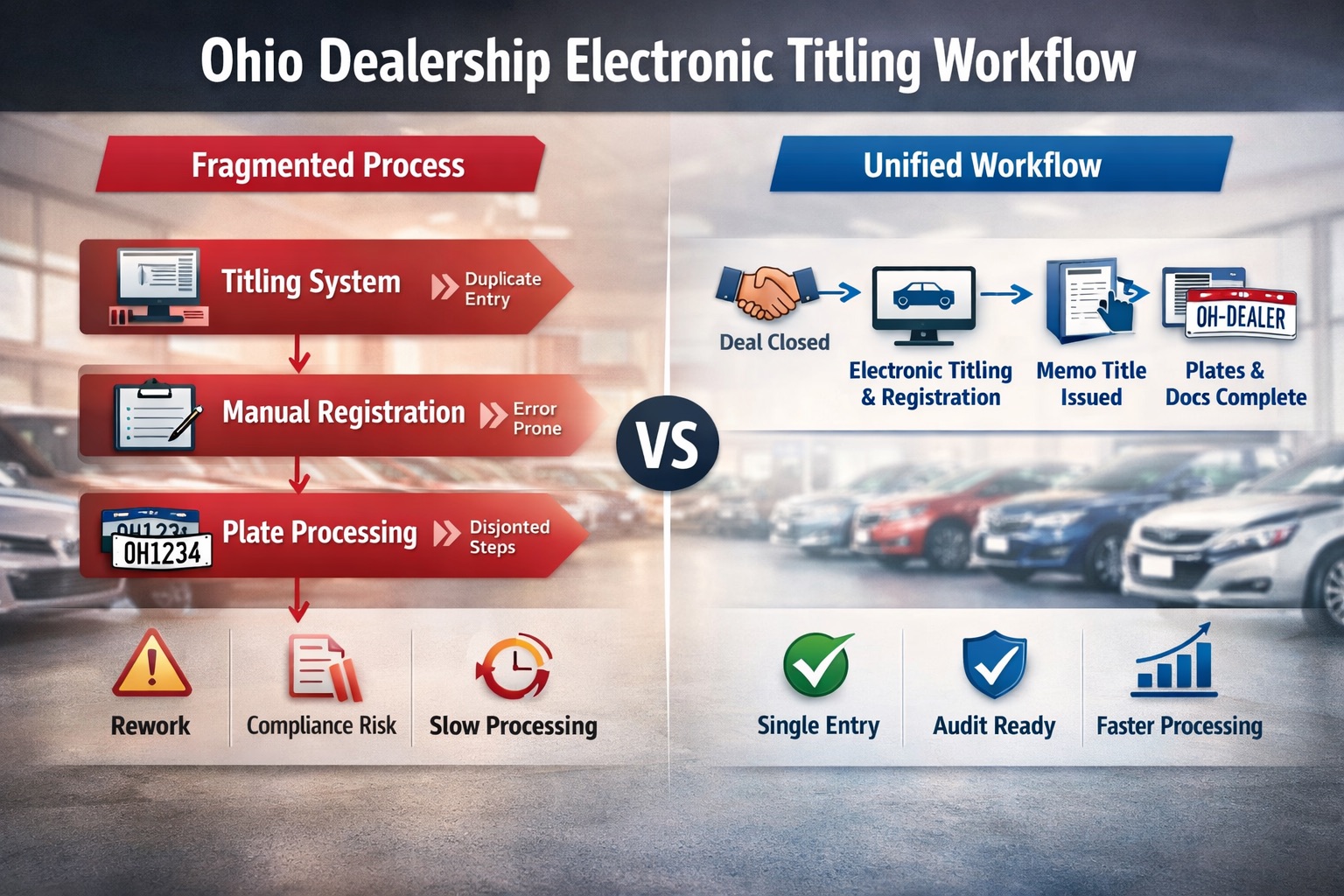
Ohio dealerships that run electronic titling, registration, and plating as separate processes create variation, rework, and documentation risk. A unified electronic titling and registration workflow brings consistency, operational control, and stronger compliance positioning across stores.
The Problem Most Dealerships Don’t See
Many dealerships believe they “have electronic titling handled.”
In reality, most operations look like this:
• Electronic titling happens in one system
• Registration steps are handled elsewhere
• Plate processing lives in a different workflow
• Documentation depends on staff habits
• Each location operates slightly differently
That is not a workflow. It is a collection of tasks.
As dealerships grow, this structure leads to:
• inconsistent execution between stores
• documentation handled differently by the department
• rework when deals move between F&I and the title office
• difficulty proving how services were performed
This becomes more important under Ohio’s updated framework, where workflow execution and documentation alignment matter. For rule context, see the Ohio Registration & Titling Service Fee guide.
Where Dealership Titling Workflows Break Down
When electronic titling and registration are separated, breakdown points appear in predictable places.
Title Office vs F&I
F&I closes the deal.
The title office executes the paperwork.
Without a unified workflow:
• F&I assumptions do not match title execution
• documentation lives in different places
• steps are repeated or skipped
Registration vs Titling Systems
Some dealerships run:
• one tool for electronic titling
• another process for registration
• manual handling for plates
This creates:
• duplicate data entry
• higher error rates
• unclear documentation trails
Ohio’s BMV electronic titling system supports submission, but it does not unify the full dealership process. That gap is where variation enters.
Multi-Location Variation
Across rooftops, differences emerge:
• one store follows strict documentation
• another relies on staff memory
• one applies workflows consistently
• another varies based on habit
Variation is where operational friction and compliance exposure begin.
What a Unified Electronic Titling and Registration Workflow Looks Like
A true dealership titling workflow:
• ties electronic titling, registration, and plating into one process
• links documentation to the transaction, not the individual
• standardizes how work is performed across stores
• reduces dependency on individual habits
• creates a clear operational trail
This is not about software features.
It is about how the work is structured.
Why Titling-Only Systems Fall Short
Electronic titling alone solves submission.
It does not solve:
• registration workflow alignment
• plating coordination
• documentation consistency
• cross-store execution standards
Dealerships that treat titling, registration, and plating as separate functions manage multiple processes instead of one unified dealership title and registration system.
Workflow Consistency Equals Operational Control
Dealerships that standardize electronic titling and registration workflows gain:
• predictable execution
• clearer documentation
• reduced rework
• fewer internal escalations
• easier training across locations
For dealer groups, scale magnifies small inconsistencies. A unified workflow reduces those gaps.
The Compliance Tie-In
Ohio’s updated framework affects more than pricing. It affects how workflows align with documentation and disclosures.
When workflow, itemization, and documentation are connected inside one structured process, dealerships are in a stronger position. See how this relates to How to Itemize Ohio Registration & Titling Fees and operational execution.
This is not about adding steps.
It is about structuring the steps already happening.
Why This Matters More as Dealerships Scale
Single-store variation is manageable.
Multi-store variation creates:
• inconsistent documentation
• uneven execution
• operational blind spots
A unified electronic titling and registration workflow gives management visibility into how work is actually performed across rooftops.
Final Thought for Dealership Operators
Electronic titling is not the end of the process.
Registration and plating are not side tasks.
They are parts of one operational workflow.
Dealerships that structure titling, registration, and documentation together gain control. Those that leave them disconnected rely on habit — and habit does not scale.
Schedule your fast, no-pressure EZ demo here:
[Schedule Your EZ E Title Demo]
FAQ CONTENT
Q1: What is an electronic titling workflow for dealerships?
An electronic titling workflow is a structured dealership process that handles title submission, document transmission, and transaction tracking through an authorized electronic system instead of paper processing. In advanced dealership operations, this workflow also connects registration, plate processing, and documentation steps into one consistent process tied to each deal, not to individual staff habits.
Q2: Why do Ohio dealerships need unified titling and registration workflows?
Ohio dealerships benefit from unified workflows because titling, registration, and plating are operationally connected. When these steps are handled in separate systems or manual processes, variation increases between stores and staff, leading to rework, errors, and documentation gaps. A unified workflow improves consistency, strengthens audit readiness, and supports clean execution under Ohio’s evolving compliance environment.
Q3: How does a unified titling workflow reduce dealership rework?
A unified workflow reduces rework by eliminating duplicate data entry, standardizing steps across departments, and tying documentation directly to each transaction. Instead of staff recreating steps or correcting errors caused by disconnected systems, the process follows one structured path, improving accuracy and reducing back-and-forth between F&I, title, and registration functions.
Q4: Does Ohio electronic titling include registration and plating?
Electronic titling itself focuses on digital title submission, but in dealership operations it is most effective when combined with registration and plating steps in a single workflow. While the state systems may treat these functions separately, dealerships that integrate titling, registration, and plate processing operationally achieve better control, documentation, and process consistency.
An Ohio Dealership’s Call to Action
If you want to see how electronic titling, registration, and documentation can live inside one structured dealership workflow:
Schedule your fast, no-pressure demo here:
[Schedule Your EZ E Title Demo]