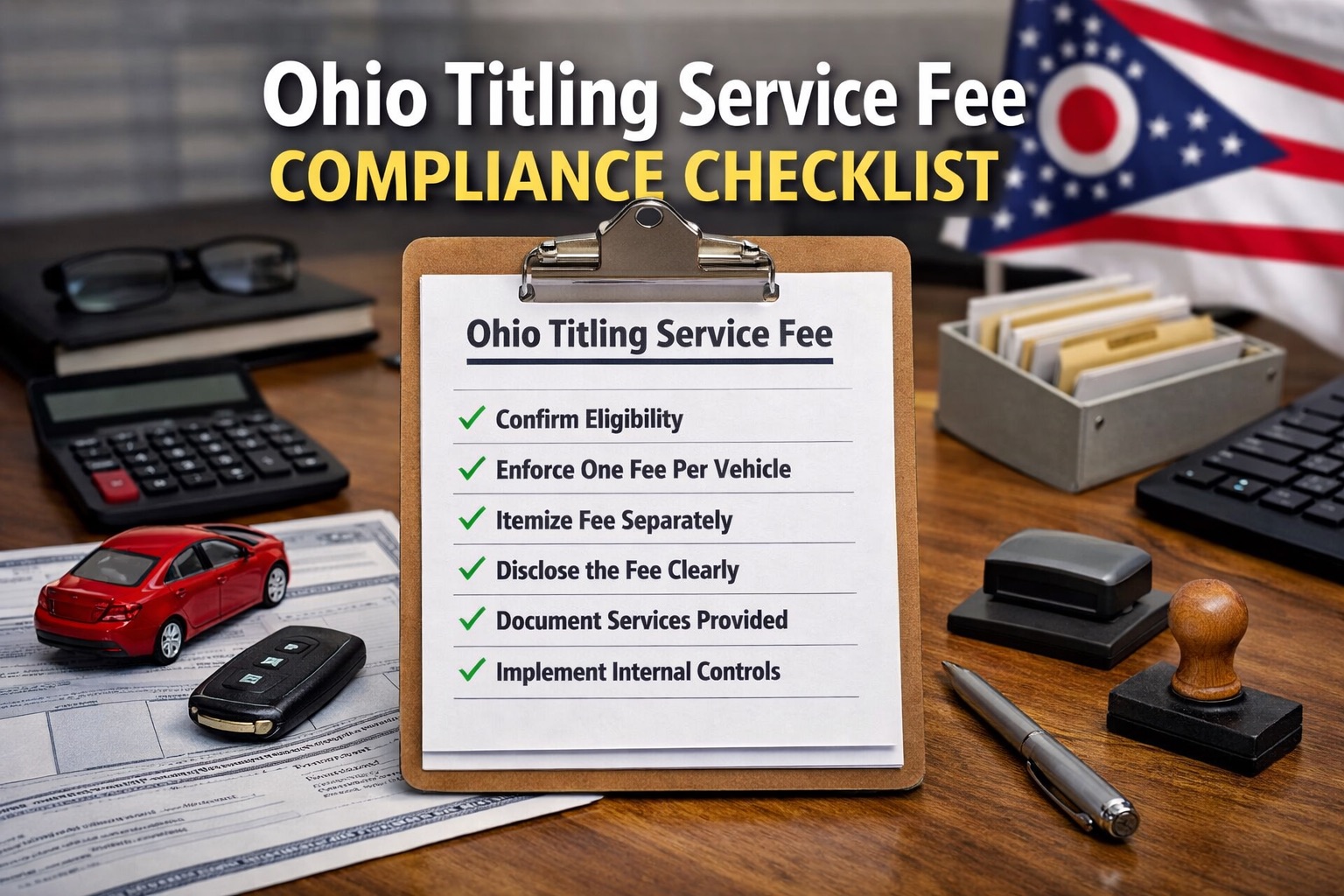
Quick Answer
What do Ohio dealerships need to comply with the Registration & Titling Service Fee rule starting March 1, 2026?
Dealerships may charge up to $50 per transaction only if they provide qualifying registration and/or dealer-paid electronic titling services, itemize the fee separately, disclose it properly, and document the workflow. The fee is optional, limited to one per vehicle, and prohibited when using Ohio BMV’s free electronic tools.
March 1 Is a Compliance Deadline — Not a Pricing Update
Starting March 1, 2026, Ohio dealerships are permitted to charge a Registration & Titling Service Fee for qualifying dealer-provided registration services and/or dealer-paid electronic titling services.
What the rule does not do is guarantee margin.
Margin exists only when the workflow, disclosures, and documentation support the charge. Without those controls, the service fee becomes an audit issue, a deal unwind risk, or a customer dispute.
This checklist is written for dealership operators, controllers, and title office leaders who need to implement the rule correctly — not as a pricing lever, but as a compliant operational process.
For the full scope of the rule, review the Ohio Registration & Titling Service Fee overview.
Step 1: Confirm Your Dealership Is Eligible to Charge the Fee
A dealership may charge the service fee only when:
• The dealership performs qualifying registration services, and/or
• The dealership pays for a third-party electronic titling system
If your store relies solely on Ohio BMV’s free electronic tools, the titling service fee is not allowed.
Eligibility is based on actual execution, not intent.
Step 2: Enforce the One-Fee-Per-Vehicle Rule
Dealerships may charge:
• One Registration & Titling Service Fee per vehicle
• Up to $50 maximum
You may not:
• Stack multiple service fees
• Apply the fee more than once
• Treat it as an automatic add-on
Even if multiple services are performed, they roll into a single itemized line.
For a breakdown of practices that create audit risk and are prohibited under the rule, see:
👉 [What Dealers Can’t Do With Ohio’s $50 Registration & Titling Service Fee]
Step 3: Itemize the Fee Correctly (No Bundling)
The service fee must be:
• Clearly itemized
• Labeled accurately
• Separated from government-imposed charges
Common compliance failures include bundling the fee into “BMV fees,” hiding it inside doc fees, or using inconsistent naming across deals.
Standardize the label across your systems.
Step 4: Disclose the Fee Clearly and Consistently
Disclosures should:
• Appear wherever other dealer-imposed fees appear
• Match the itemized name exactly
• Avoid misleading language
If your disclosure says “may apply” but the fee appears on every deal, that’s a mismatch.
Consistency is compliance.
Step 5: Document the Services Performed
This is where most dealerships fail audits.
Your dealership should be able to show:
• What service was performed
• When it was performed
• Which system was used
• That the dealership incurred operational effort or system cost
Documentation may include:
• Electronic title submission records
• Registration workflow logs
• System reports
• Internal processing checklists
If you cannot prove it, you should not charge it.
Dealerships modernizing workflows often use structured systems to keep this documentation aligned. See how Ohio dealership registration software supports standardized documentation.
Step 6: Implement Internal Controls Before March 1
Dealerships that pass audits treat this as a process, not a line item.
Minimum internal controls include:
• Documented registration and titling workflow
• Defined eligibility rules by deal type
• Standardized fee naming
• Staff training for F&I and title offices
• Periodic internal reviews
Compliance improves when workflow is enforced through systems rather than memory.
How Compliance-First Platforms Differ: Dealerships using this Ohio titling service fee compliance checklist as a workflow baseline
Some electronic titling platforms focus on transaction speed.
Compliance-ready platforms focus on:
• Audit-ready reporting
• Consistent fee enforcement
• Workflow documentation
• Dealer-paid service validation
As Ohio increases scrutiny around service fees, the difference between “electronic” and “audit-ready” becomes material.
Compliance Starts With a Repeatable Workflow
A checklist can help a dealership understand what to review, but the process still has to work in the store.
Fee consistency depends on more than knowing the rule.
The dealership also needs a workflow that supports registration and titling activity, documentation, itemization, title clerk visibility, and consistent handling across transactions.
That is why electronic titling and workflow control matter.
The store needs a process that makes the right steps easier to follow, not harder to remember.
Dealers can review the main Ohio Registration and Titling Service Fee page for the broader fee overview.
For the workflow behind the process, see Dealer Electronic Titling System Ohio.
Frequently Asked Questions
Can Ohio dealers charge a titling service fee?
Yes — but only when qualifying registration or dealer-paid electronic titling services are performed, and all compliance requirements are met.
Is the $50 fee mandatory?
No. The fee is optional and may not be treated as automatic revenue.
Can the fee be bundled with other charges?
No. It must be separately itemized and clearly disclosed.
Can dealers charge the fee when using free BMV tools?
No. The titling service portion of the fee is not permitted when only free BMV tools are used.
What happens if a dealership fails to document services?
The fee becomes difficult to defend in audits, disputes, or chargebacks.
Final Thought for Dealership Operators
March 1 does not reward intent.
It rewards execution.
Dealerships that treat the Registration & Titling Service Fee as a compliance workflow — not a pricing tweak — avoid downstream issues and protect revenue long-term.
Before implementation, review your full Ohio title transfer process for dealerships to ensure operational alignment.
For a complete guide to the Ohio Registration & Titling Service Fee — including eligibility, prohibited practices, and proper itemization — see the dealer compliance hub.
Set up your fast, no-pressure demo here:
Schedule Your EZ E Title Demo